Problem and user
Reduce repeated repository switching and make the state of development work visible.
Builders managing multiple repositories and local services.

Local developer tool
A local workspace that brings Git, services and development tools into one operating view.
Problem and user
Builders managing multiple repositories and local services.
My role
Outcome and status
Learning
Reducing repeated transitions is useful only when the scope of an action remains clear.
Next step
Validate grouped workflows and improve recovery guidance.
TL;DRA local workspace that brings Git, services and development tools into one operating view.
Building several products at once creates a second job: remembering which repository needs attention, which service is running and which change still needs to be committed. Sympol turns that fragmented routine into a local workspace with a common view of the work.
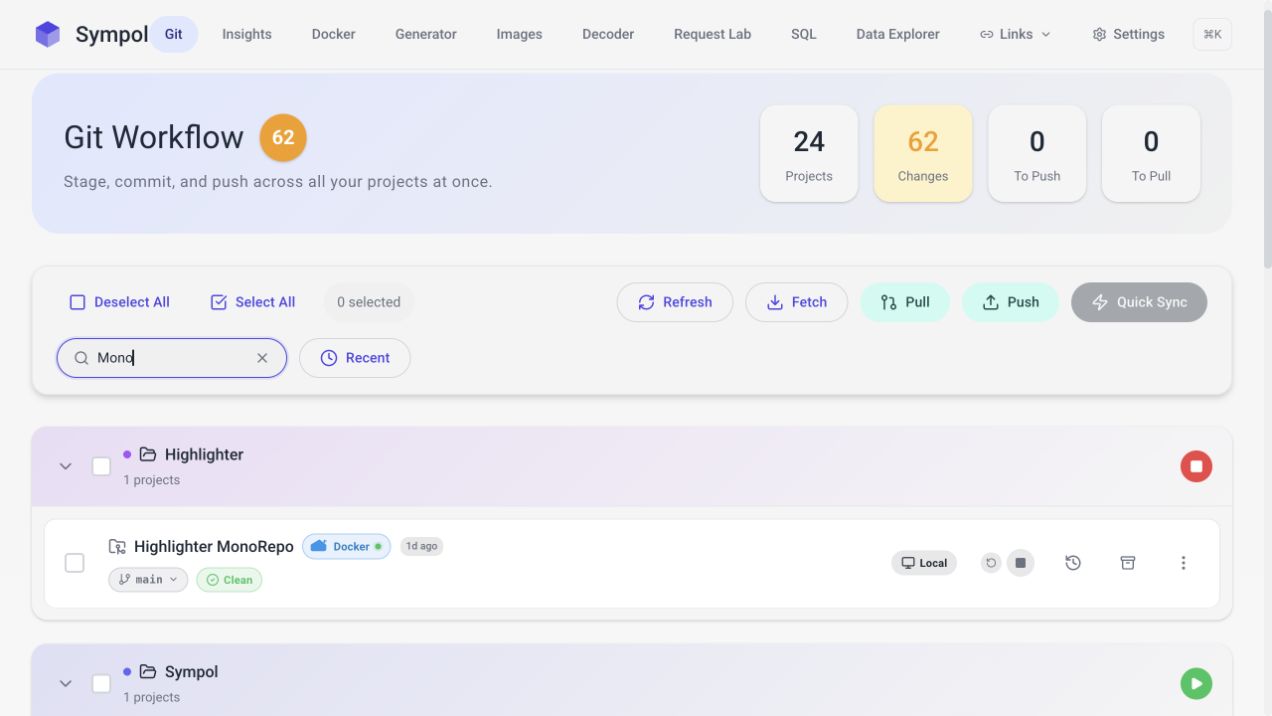
The Git workflow is the clearest entry point. Projects are grouped, changes are visible, and selected repositories can be pulled, pushed or synchronised together. A quick-sync flow combines staging, committing and pushing; reusable commit messages make the repetitive part of delivery easier to repeat consistently.
The workspace extends into Docker controls and port visibility, a request lab for API exploration, SQL and data tools, and project and image generation. These capabilities bring the practical context around a repository closer to the work itself. The product connects the places a builder repeatedly visits rather than asking them to remember another collection of disconnected tools.
The important design decision is visibility before action. A group-level view exposes the state of multiple repositories, while expandable project details preserve access to the files underneath. Batch operations reduce repetition without removing the need to understand the scope of a change.
A SvelteKit interface sits over a local Python Flask backend. GitPython provides the repository integration, and JSON configuration keeps the workspace understandable and portable. The local execution model gives the tool access to development repositories and the host's Docker environment.
Sympol shows how a recurring personal workflow can become a coherent product: identify the repeated transitions, make state visible, and put related actions in one place. It is an example of product engineering at the boundary between interface design, local tooling and operational automation.
The next validation step is to assess where grouped actions save useful time and where additional confirmation or recovery information is needed. No measured productivity improvement is claimed here.
A shared view of household money, from everyday capture to budgets and forward planning.
The South African pub dice game, with online rolls, real-table scorekeeping and persistent group history.
Find the useful moments in long videos, with connected transcripts, frames and engagement signals.
Turn a booking, message or school note into a calendar draft you can review, edit and export.
Make German practice easier to return to, with vocabulary review, exam preparation and short Word Sprint games.
An F1 data project started in 2018, adapted into an API and a traceable source pipeline for new product ideas.
A daily football trivia game that turns a player’s career into clues, with a leaderboard to bring people back.
A private home marketplace that makes interest, reservations and handovers easier to coordinate.
Building with AI